
Best Agentic AI Tools: 20 Solutions to Know in 2026

Agentic AI is moving from answering to doing—planning multi-step work, taking actions across your tools, and adjusting as conditions change. The right agentic platform can eliminate whole categories of busywork while keeping humans in control when it matters.
What are agentic AI tools?
Agentic AI tools are software systems that can act autonomously, completing tasks or achieving goals with minimal human intervention. Unlike traditional AI, which requires step-by-step instructions or oversight, agentic AI tools operate with independently defined objectives and can plan, execute, and adjust their actions as needed. They integrate machine learning, large language models, and reasoning models to assess situations, select strategies, and self-direct their workflow.
Modern agentic AI tools have robust decision-making abilities, allowing them to handle multi-step processes or adapt to unexpected inputs. This presents an evolution beyond basic automation or rule-based systems. By identifying user intentions, breaking down complex requirements, and proactively refining their approach, agentic AI tools streamline workflows in areas like marketing, event management, business process management, research and development, driving productivity and freeing human users for more strategic work.
4 key characteristics of agentic AI tools
Here are some of the main characteristics that define agentic AI technologies.
1. Autonomy
At the core of agentic AI is autonomy, defined as the ability for a tool to make decisions and take actions without constant human oversight. Instead of responding to pre-defined triggers, autonomous AI agents receive goals or high-level instructions and determine the most effective sequence of actions to achieve them. This autonomy enables them to prioritize tasks, resolve conflicts, and navigate uncertainty, making them more flexible than static automation scripts.
Such autonomy also means agentic AI tools can monitor their own progress and make on-the-fly adjustments. If an error occurs or priorities change, the tool can adapt its strategy, reroute actions, and continue towards the goal. This continuous self-direction reduces the reliance on manual input, making these systems valuable for complex environments where human supervision of each step is impractical.
2. Complex task management
Agentic AI tools excel at managing tasks that involve multiple steps, dependencies, or conditional actions. Rather than executing a single operation, these tools coordinate a series of interconnected activities, dynamically sequencing them based on current conditions and overall objectives. This enables businesses and organizations to automate workflows that previously required dedicated human attention and oversight.
Managing complexity also involves resource allocation, error detection, and progress tracking. Agentic AI is typically equipped to break down large problems into manageable units, delegate tasks (where appropriate), and aggregate results for reporting or further action. This multi-layered control is fundamental to their value proposition in automating sophisticated processes.
3. Adaptability
Adaptability is vital for agentic AI, allowing these tools to adjust their operations according to evolving circumstances. Agentic systems leverage feedback—either from the environment or from user input—to refine their actions in real time. When faced with new data, obstacles, or changing requirements, these systems can re-plan, reprioritize, and alter their approach to maintain performance continuity.
This adaptability makes agentic AI tools especially effective in dynamic or unpredictable environments. Instead of failing or requiring manual intervention when unexpected changes occur, they are designed to operate resiliently—learning from previous experiences and incorporating those lessons to improve future outcomes.
4. Collaboration
Many agentic AI solutions are built with collaboration in mind, capable of working alongside humans or within a network of AI agents. They facilitate smooth information exchange, integrate with other tools or APIs, and mutually coordinate efforts on shared objectives. This collaborative ability amplifies their usefulness, especially in environments where multiple stakeholders or tools must synchronize their actions.
Effective collaboration also allows agentic AI to receive contextual guidance, clarify ambiguities, and escalate issues when beyond their scope. This human-in-the-loop design enhances trust and reliability, allowing organizations to extract the benefits of autonomy while retaining oversight for sensitive or high-risk scenarios.
Key use cases of agentic AI tools
Agentic AI has a myriad of exciting use cases, and many new uses are soon to be discovered. Here are a few areas where AI agents are already making an impact.
AI-powered video management
Agentic AI tools are increasingly central to enterprise video management, enabling intelligent automation across the full video lifecycle, from creation to delivery and optimization. These tools can autonomously handle tasks such as video production, moderation, personalization, and accessibility, reducing the need for manual editing or review. By leveraging agentic AI, organizations can streamline workflows related to internal communications, webinars, virtual events, and customer engagement.
Another key advantage is automated content enrichment. Agentic AI systems can generate captions, chapters, summaries, and interactive elements like quizzes or clips. This enhances both accessibility and viewer engagement while extending the value of existing content assets. These tools can also personalize video experiences in real time, tailoring recommendations or messaging based on user behavior, preferences, or role within the organization.
Learn more about Kaltura’s agentic AI video platform
Business process automation
Agentic AI tools are redefining business process automation by handling end-to-end workflows that traditionally required human management. They can integrate with enterprise software suites, automate data collection, trigger cross-system processes, and resolve issues, flagging human intervention only when necessary. This streamlining delivers faster throughput, reduces operational costs, and ensures more consistent output quality.
By automating multi-stage business tasks—such as invoice processing, compliance checks, or inventory management—agentic AI reduces manual errors and operational delays. Its ability to respond autonomously to exceptions or shifting priorities means businesses become more agile and can focus workforce efforts on areas of unique value rather than repetitive administration.
Customer support
Agentic AI tools expand customer support capacity by managing complex queries, troubleshooting issues, and guiding users through intricate problem-solving processes. Unlike chatbots limited to FAQs or scripted flows, modern agentic AI tools can interpret nuanced requests, engage in multi-turn conversations, and resolve cases end-to-end, often across multiple platforms or data sources.
Their adaptability allows them to escalate particularly sensitive or unresolved cases to human agents, ensuring a seamless customer experience. By proactively gathering relevant background information and proposing solutions, agentic AI not only reduces response times but also improves first-contact resolution rates, contributing to higher customer satisfaction and retention.
Knowledge management
Agentic AI tools improve knowledge management by autonomously organizing, updating, and retrieving information across large and distributed datasets. Instead of relying on static indexing or manual curation, these systems can extract insights from unstructured data, classify documents, and maintain knowledge bases that stay current as new information appears.
They can also act as intelligent intermediaries, connecting users to the most relevant resources by interpreting context and intent. This reduces time spent searching across fragmented repositories and ensures decision-makers work with accurate, up-to-date knowledge. For enterprises, this capability helps maintain institutional memory, supports compliance with documentation requirements, and enhances overall information accessibility.
Personalization
Personalization is a core strength of agentic AI, enabling tools to tailor interactions and outputs to individual users or groups. By continuously learning from user behavior, preferences, and feedback, these systems can adjust recommendations, workflows, or communication styles without requiring explicit instructions.
This capability is valuable in domains such as marketing, e-commerce, and digital learning, where adaptive experiences drive engagement and effectiveness. For example, an agentic AI system can customize product suggestions, refine educational pathways, or configure software dashboards to match specific user needs. The result is a more efficient and user-centric environment where automation aligns closely with human expectations.
Software development
Agentic AI is impacting software development through tools that can write, test, and refactor code autonomously. Developers can specify a goal, such as implementing a feature or fixing a bug, and the AI tool will determine requirements, generate code, execute tests, and optimize outcomes. This enables teams to scale productivity beyond manual limits and maintain high code quality.
Such systems can also integrate feedback from code reviews, adjust their development strategies, and collaborate with human programmers on complex projects. As a result, organizations achieve faster time-to-market, enhanced reliability, and greater adaptability to shifting requirements in software products.
Notable agentic AI tools
AI-powered video creation
1. Kaltura

Kaltura’s Agentic Avatars are autonomous, context-aware AI agents that can reason, adapt, and act across internal communications, learning, customer support, marketing, and digital events. Rather than static playback videos, Kaltura applies agentic AI to the full video lifecycle, turning videos, documents, and knowledge bases into real-time, conversational experiences that guide users toward clear outcomes.
Kaltura’s Agentic Avatars interpret intent, draw from approved enterprise content in real time, and dynamically guide users step by step, reducing reliance on manual workflows, scripted chatbots, or fragmented video tools. This directly addresses a core enterprise pain point: scaling personalized, high-quality customer or employee experiences without increasing headcount or operational complexity
- Real-time agentic video conversations: Avatars listen, reason, and respond live, guiding users through complex topics, processes, or decisions instead of serving pre-recorded or linear content.
- Autonomous task guidance: Agents are goal-driven, able to manage multi-step interactions such as onboarding, learning progression, support resolution, or lead qualification with minimal human intervention.
- Knowledge-grounded intelligence: Avatars operate exclusively on approved videos, documents, FAQs, and datasets, ensuring accuracy, consistency, and enterprise trust.
- Adaptive personalization at scale: Conversations adapt dynamically based on user intent, role, behavior, and context, enabling one-to-one experiences across thousands or millions of users.
- Enterprise-grade governance: Built-in guardrails, compliance controls, multilingual support, and secure deployment meet the needs of regulated and global organizations.
- Omnichannel deployment: Avatars can be embedded across websites, portals, LMSs, webinars, virtual events, help centers, and internal platforms for consistent guidance everywhere.
By combining agentic autonomy, real-time adaptability, and enterprise video infrastructure, Kaltura positions video not just as content, but as an intelligent interface. This makes it particularly well-suited for organizations looking to replace fragmented video workflows with a single, scalable agentic layer that drives clarity, engagement, and measurable outcomes across the business.
2. HeyGen

HeyGen is an AI video generation platform to automate the creation of realistic, avatar-based videos. It supports multiple input types, including text, images, and audio, and produces full-length videos with voiceovers, facial expressions, and gestures.
Key features include:
- Avatar generation: Create lifelike avatars from text, images, or video for personalized video content
- Text/image/audio to video: Supports multiple input formats to quickly generate branded, on-message video assets
- Multilingual video translation: Automatically translate and lip-sync videos into over 175 languages
- Voice cloning: Maintain speaker identity and tone across translated content
- AI video editing studio: Text-based interface for editing and directing videos without manual tools
- Custom branding and collaboration: Upload logos, fonts, and color schemes; collaborate with teams in-platform

Source: HeyGen
3. Hippo Video

Hippo Video is a video automation platform that uses agentic AI to simplify video creation, personalization, and distribution. It enables teams to convert scripts or documents into personalized, avatar-driven videos in 30+ languages. Built-in agents manage everything from creation and editing to campaign scaling.
Key features include:
- Agentic video creation: Use the Creation Agent to generate AI videos from scripts, presentations, or documents
- Scalable personalization: Campaign Agent produces customized video campaigns with polls, CTAs, and quizzes
- AI-powered avatars: Video Co-Pilot creates realistic, humanlike avatars that deliver content in any language
- End-to-end automation: Automates video production, distribution, and optimization with real-time performance tracking
- Multilingual support: Create videos in over 30 languages with accurate voice and accent rendering
- Real-time video assistance: AI video bot interacts with users through voice and video for support or onboarding

Source: HippoVideo
Business process automation
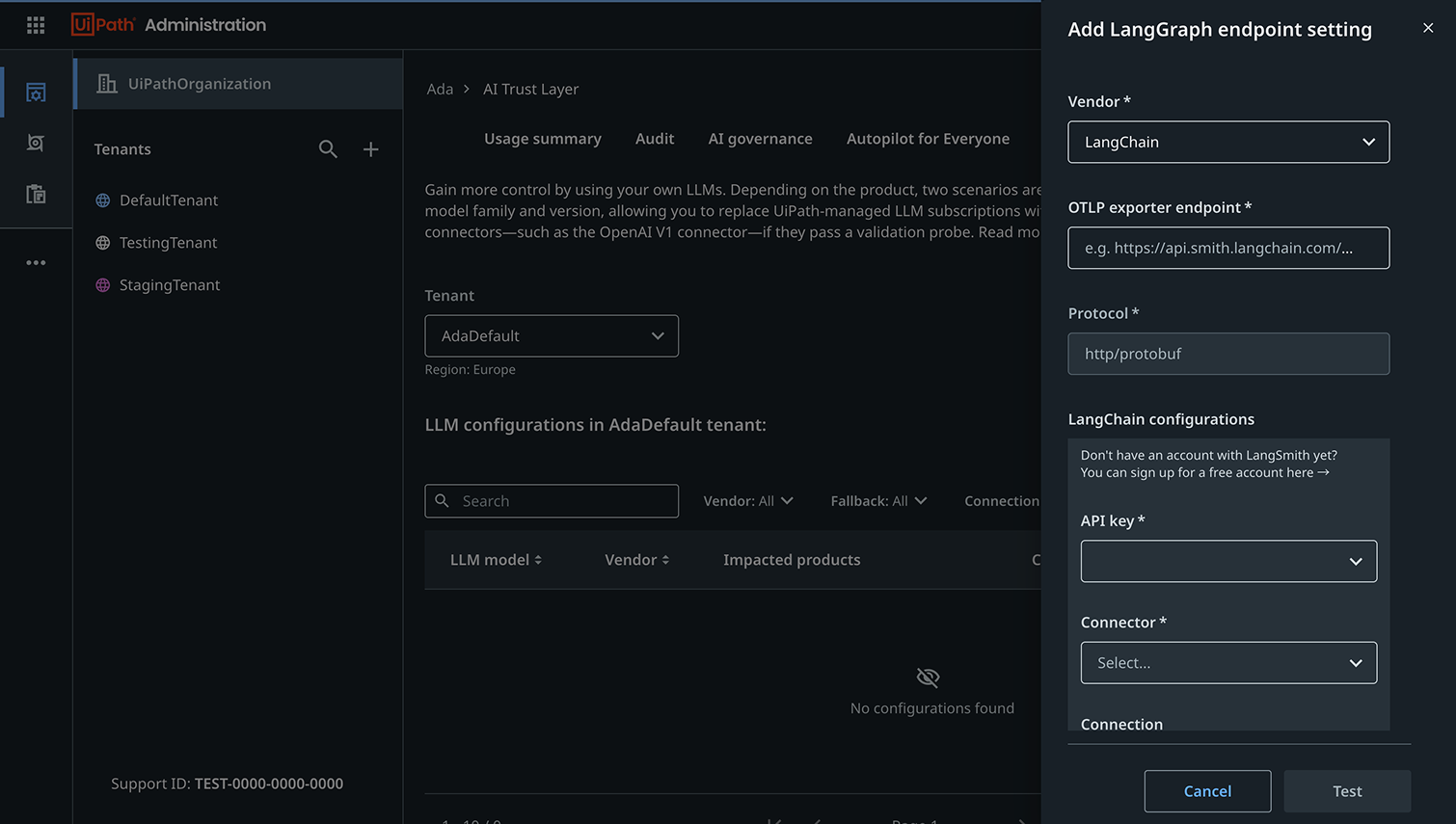
4. UiPath Agentic Automation

UiPath delivers a full-stack agentic automation platform that connects AI agents, robotic process automation (RPA), and human decision-making. It allows organizations to design, orchestrate, and govern AI-powered workflows that adapt to changing business conditions. The platform includes tools like Agent Builder and Maestro for building and coordinating agents.
Key features include:
- End-to-end orchestration: Coordinate agents, robots, and human input through a unified control layer
- Agent Builder: Create and deploy customized AI agents for tasks like invoice dispute resolution or HR processing
- Conversational productivity agents: Boost productivity with agents that assist in natural language across roles
- Self-healing automation: Healing Agent adapts to UI changes without breaking automated workflows
- Low-code development: Combine prebuilt templates and custom logic for fast deployment
- Enterprise governance: Enforces security, reliability, and compliance across agentic workflows

Source: UiPath
5. Blue Prism

Blue Prism offers an agentic automation platform to support large-scale enterprise operations. It enables organizations to shift from deterministic, rules-based automation to dynamic agentic workflows that can make autonomous decisions. With over 2,700 agents in live production, Blue Prism is widely used in finance, healthcare, and the public sector.
Key features include:
- Agentic orchestration: Automates and coordinates tasks across systems using intelligent agents
- Operational scalability: Supports high-volume processes with over 150 million transactions processed
- Cross-industry applicability: Used in sectors like insurance, banking, healthcare, and government
- Governed automation: Maintains strong compliance and control frameworks for secure AI execution
- Agent catalog: Offers a prebuilt library of agents for common business scenarios
- Innovation lab support: Provides tools and guidance for operationalizing agentic AI within enterprises
6. Beam AI

Beam AI is an agentic automation platform designed to help enterprises build, deploy, and manage AI agents for a wide range of business processes. Users can create agents using natural language, document uploads, or a visual flow builder. The platform supports over 1,500 integrations and includes features for real-time testing and one-click deployment.
Key features include:
- Conversational agent creation: Build agents by describing tasks in natural language; AI asks follow-up questions and auto-generates workflows.
- Visual flow builder: Drag-and-drop interface with full support for logic, conditions, loops, and integrations.
- Document-based agent memory: Upload SOPs or manuals for semantic search and workflow execution referencing internal documentation.
- Prebuilt workflow templates: Use or customize tested agents for use cases like invoice processing or email triage.
- Enterprise integrations: Instantly connect to platforms like Salesforce, SAP, Oracle, or Workday.
- Real-time testing and debugging: Simulate workflows with real data before deployment and inspect each execution step.
- Solution engineering support: Expert assistance in design, integration, and optimization for enterprise-scale rollout.

Source: Beam
Customer support
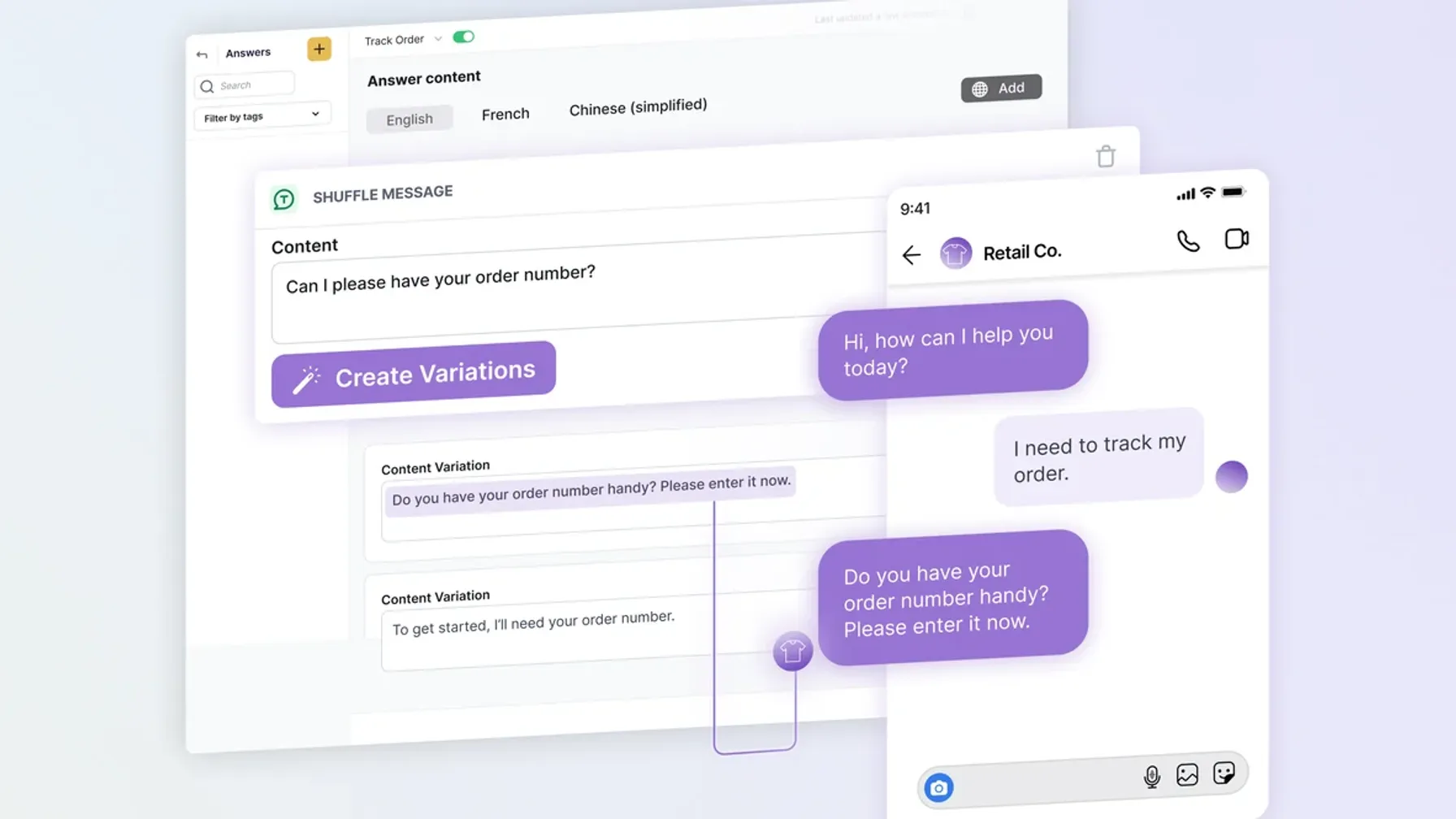
7. Ada’s AI Agent

Ada provides enterprise-grade agentic AI for omnichannel customer service. Its Reasoning Engine supports autonomous decision-making, enabling agents to manage complex, multi-step customer interactions across channels such as chat, voice, email, and messaging apps. The platform includes structured Playbooks, performance monitoring, and developer tools.
Key features include:
- Reasoning Engine: Coordinates multiple large language models to deliver accurate, context-aware responses.
- Omnichannel conversation hub: Deploys agents across voice, chat, SMS, email, WhatsApp, and custom channels.
- Structured Playbooks: Handle multi-step workflows using real-time data, enabling task automation beyond scripted bots.
- Performance Center: Offers analytics and controls to launch, monitor, and optimize agents.
- Coaching and feedback loop: Enables continuous improvement by applying edits from past conversations to future responses.
- Enterprise integration support: Connects with tools like Zendesk, Salesforce, and Twilio to automate backend actions.

Source: Ada
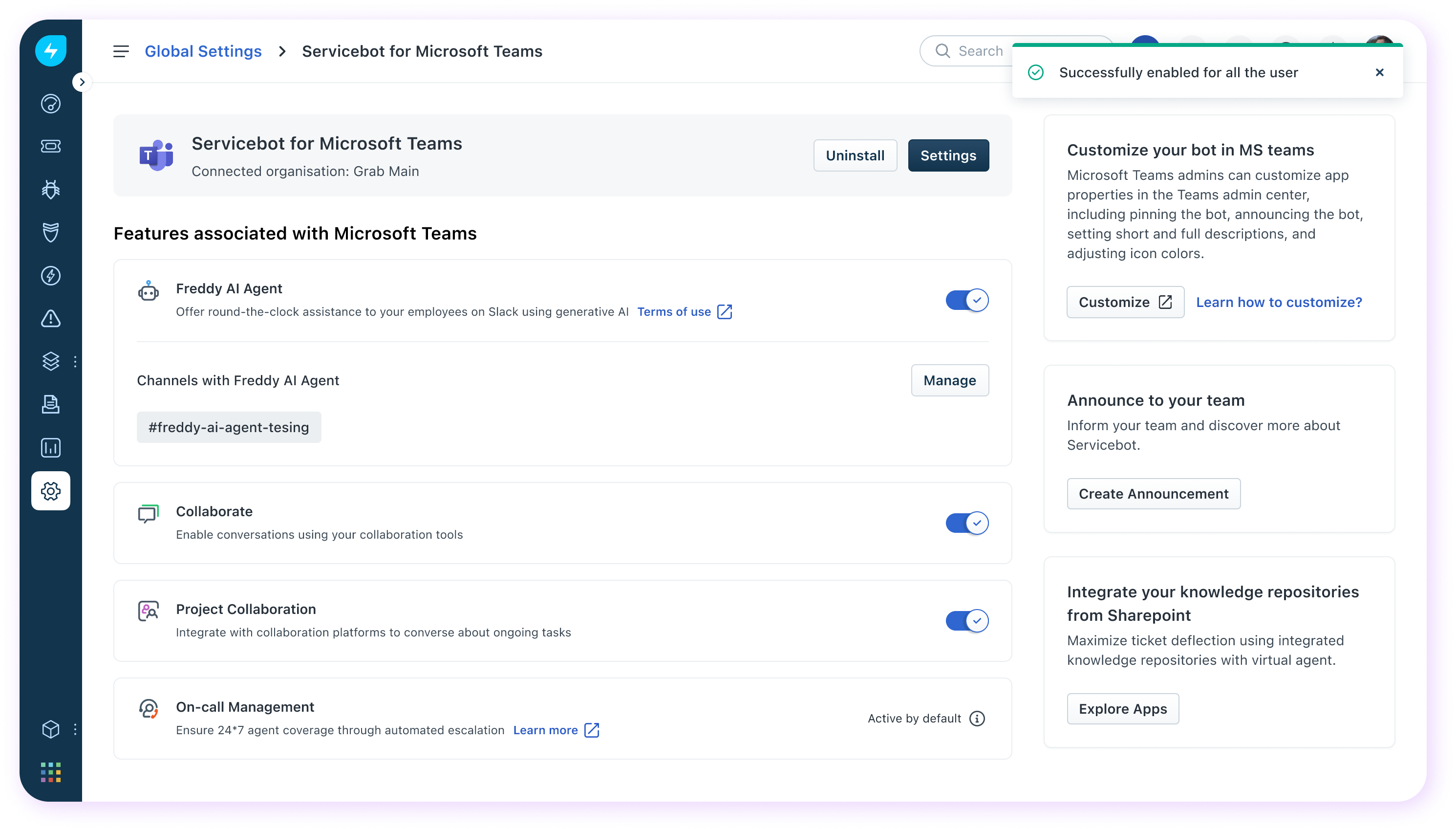
8. Freshworks Freddy AI Agents

Freddy AI Agents are agentic tools from Freshworks that automate customer support tasks across channels. Built with pre-configured vertical-specific workflows, Freddy can take actions directly from conversations and escalate when needed. It supports various languages and integrates with platforms like Shopify, Stripe, and FedEx to automate business operations.
Key features include:
- Ready-to-launch AI agents: Prebuilt agents for common verticals with over 50 agentic workflows out of the box.
- Actionable AI: Agents connect to backend systems to process refunds, update orders, and schedule pickups.
- Intelligent escalation: Transfers conversations to humans with full context and conversation history.
- Omnichannel coverage: Operates consistently across chat, email, WhatsApp, social, and in-app messaging.
- Email AI agent: Reads and responds to email tickets automatically, improving resolution times.
- Multilingual support: Converses in over 60 languages with human-like tone and understanding.
- Agent Studio interface: No-code builder for custom AI agents tailored to specific business needs.

Source: Freshservice
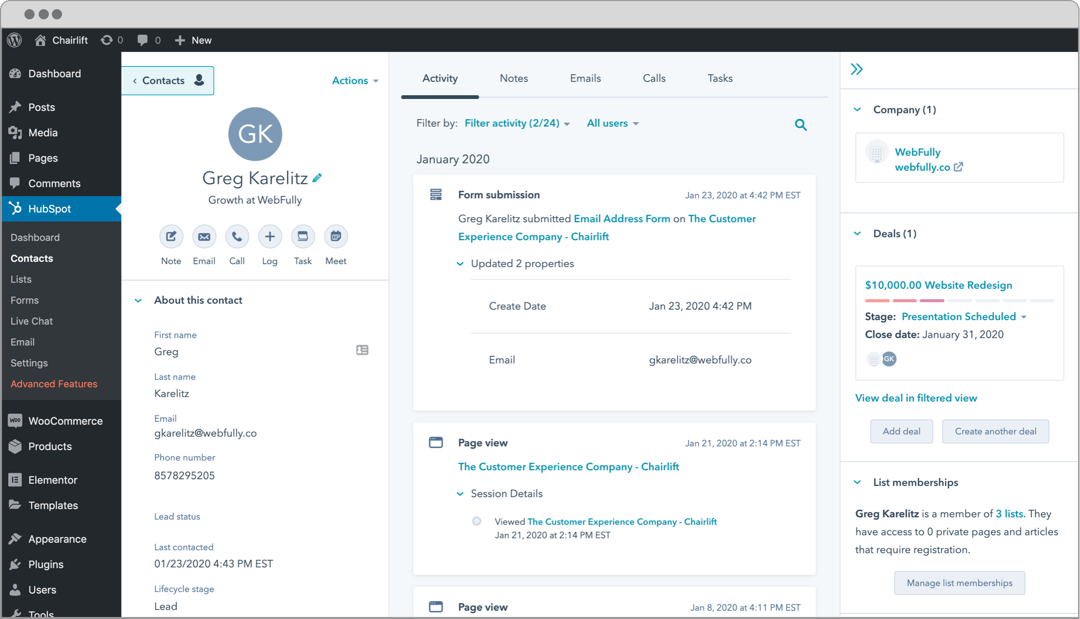
9. HubSpot Breeze Agent

HubSpot’s Breeze Agents are agentic assistants integrated across marketing, sales, and service workflows. Built through Breeze Studio, they automate tasks like customer support, prospecting, content creation, and analytics. Breeze Agents are customizable and operate based on the organization’s data, content, and brand voice.
Key features include:
- Cross-functional agents: Automate roles in customer service, sales prospecting, deal closing, and knowledge management.
- Custom agent studio: Breeze Studio allows customization of workflows, brand tone, and approval logic.
- Marketplace of AI agents: Access a growing library of prebuilt agents tailored to common business scenarios.
- Continuous improvement: Built-in analytics track agent performance and guide optimization over time.
- Data-driven decision-making: Agents analyze CRM data, documents, and web content to answer complex questions.
- Integrated personalization: Tailors websites, CTAs, and outreach strategies based on customer segments.

Source: Hubspot
Knowledge management
10. Kaltura Work Genie
Kaltura Work Genie is an agentic knowledge management assistant that transforms enterprise content into instant, personalized intelligence. Rather than acting as a static search or documentation tool, Work Genie autonomously interprets user intent, retrieves knowledge from multiple trusted sources, and delivers clear, context-aware answers in real time. It is designed to help employees, customers, and partners find, understand, and apply knowledge without navigating fragmented repositories or outdated documentation
Work Genie addresses a core enterprise challenge: organizations generate vast amounts of content, but users struggle to find the right information when it matters. By operating exclusively on approved organizational knowledge (videos, documents, FAQs, and structured data), Kaltura Work Genie ensures accuracy, prevents hallucinations, and keeps institutional knowledge current and actionable. This makes it especially effective in regulated or mission-critical environments where trust and consistency are essential
Key features include:
- Internal multi-source search engine: Retrieves and synthesizes answers from multiple enterprise content sources, delivering concise, well-rounded responses instead of isolated documents.
- Context-aware knowledge retrieval: Interprets user role, intent, and engagement history to surface the most relevant information automatically.
- Interactive learning experiences: Converts knowledge into quizzes, flashcards, video snippets, and visual extracts that reinforce understanding and retention.
- Adaptive guidance and next steps: Suggests follow-up actions or learning paths to close knowledge gaps and strengthen comprehension over time.
- Enterprise-grade permissions and security: Ensures the right users access the right content, with full control over visibility, governance, and data protection.
- Responsible AI design: Uses only verified organizational content, never trains models on customer data, and avoids ungrounded AI outputs.
By combining agentic reasoning with enterprise content governance, Work Genie moves knowledge management from passive storage to active enablement. It functions as a personal knowledge assistant for every user—reducing time spent searching, preventing information loss, and turning institutional knowledge into a living system that continuously supports productivity, learning, and decision-making across the organization.
11. Smartcat

Smartcat is an agentic AI platform focused on translation and global content management. It combines AI-powered translation, content generation, and human-in-the-loop workflows to automate the creation and localization of content in over 280 languages.
Key features include:
- AI translation and content generation: Automatically translate and generate content across websites, software, e-learning, and marketing assets
- Human-in-the-loop workflows: Combine AI translation with professional editing via Smartcat’s linguist marketplace
- Content integrations: Connects with tools like Figma, Jira, WordPress, and Salesforce to simplify localization workflows
- Translation project management: Centralizes supplier coordination, automates payouts, and manages language assets at scale
- Adaptive learning: Continuously improves translation quality using edit history and user feedback
- Multi-format support: Supports over 50 file types, including PDF, JSON, and DOCX, for diverse content needs
12. Confluence Rovo

Confluence Rovo is Atlassian’s agentic AI solution to unify and surface knowledge across tools like Confluence, Jira, and Slack. Built around a “Teamwork Graph,” Rovo enables teams to generate, refine, and organize content through AI agents that understand organizational context.
Key features include:
- Context-aware search: Rovo Search connects information across Confluence, Jira, Slack, and other tools to provide fast, relevant answers based on organizational knowledge.
- AI-powered content creation: Assists users in generating, polishing, and transforming content from whiteboards to documentation to Jira tasks.
- Meeting insights reporter: Extracts key points, action items, and summaries from recorded meetings, making it easier to stay aligned.
- Brainstorm facilitator agent: Supports ideation sessions by guiding teams through structured brainstorming processes.
- Agent studio for customization: Allows users to build and deploy custom AI agents tailored to their team’s workflows or language.
- Collaborative AI chat: Enables natural interaction with AI agents for knowledge retrieval, task iteration, and project updates.

Source: Atlassian
13. Document360 agent

Document360’s AI writing agent, powered by Eddy AI, is intended to automate the creation and refinement of knowledge base content. It enables technical writers and content teams to rapidly generate articles from prompts, documents, transcripts, audio, or video. It integrates AI-driven formatting, metadata generation, and style guide adherence.
Key features include:
- Automated content generation: Create full articles from text prompts, uploaded files (e.g., DOCX, MP3, TXT), or even video and audio transcripts.
- Style guide enforcement: Apply predefined or custom style guides for tone, structure, SEO metadata, and branding consistency.
- Content creation from video: Extracts screenshots and text from short videos to generate instructional or how-to articles.
- Real-time refinement tools: Modify tone, length, voice (active/passive), and format post-generation with simple prompts.
- Multilingual support: Generate and refine content in all languages supported by the platform.
- Usage tracking and credit system: Manage AI generation limits based on project plans, with controls to monitor and purchase additional credits as needed.

Source: Document360
Personalization
14. Kaltura Content Labs
Kaltura Content Labs is an agentic personalization solution that uses AI-driven automation to transform source videos and assets into modular, reusable components that can be dynamically assembled and personalized based on audience, context, and intent. This allows teams to scale relevance across marketing, learning, communications, and customer engagement without increasing production overhead.
Content Labs automatically generate clips, chapters, summaries, metadata, and variations, enabling organizations to tailor content to different roles, regions, languages, and use cases while maintaining brand consistency and governance. The result is faster time-to-market, higher engagement, and more efficient use of existing content investments.
Key features include:
-
AI-driven content modularization: Automatically breaks long-form video into reusable chapters, clips, and highlights that can be recombined across experiences.
-
Dynamic personalization at scale: Tailors content versions based on audience attributes, use case, language, or delivery context without manual duplication.
-
Automated content enrichment: Generates summaries, titles, chapters, and metadata to improve discoverability and relevance across channels.
-
Reusable content workflows: Enables teams to repurpose a single source asset across marketing, learning, and communications while preserving consistency.
-
Enterprise governance and control: Ensures personalization operates within approved content, brand rules, and compliance requirements.
-
Seamless integration with video experiences: Designed to work natively across Kaltura’s video portals, events, learning platforms, and digital experiences.
Kaltura Content Labs allows organizations to move beyond static personalization rules and toward adaptive, scalable content experiences, maximizing the value of every asset while delivering relevance at enterprise scale.
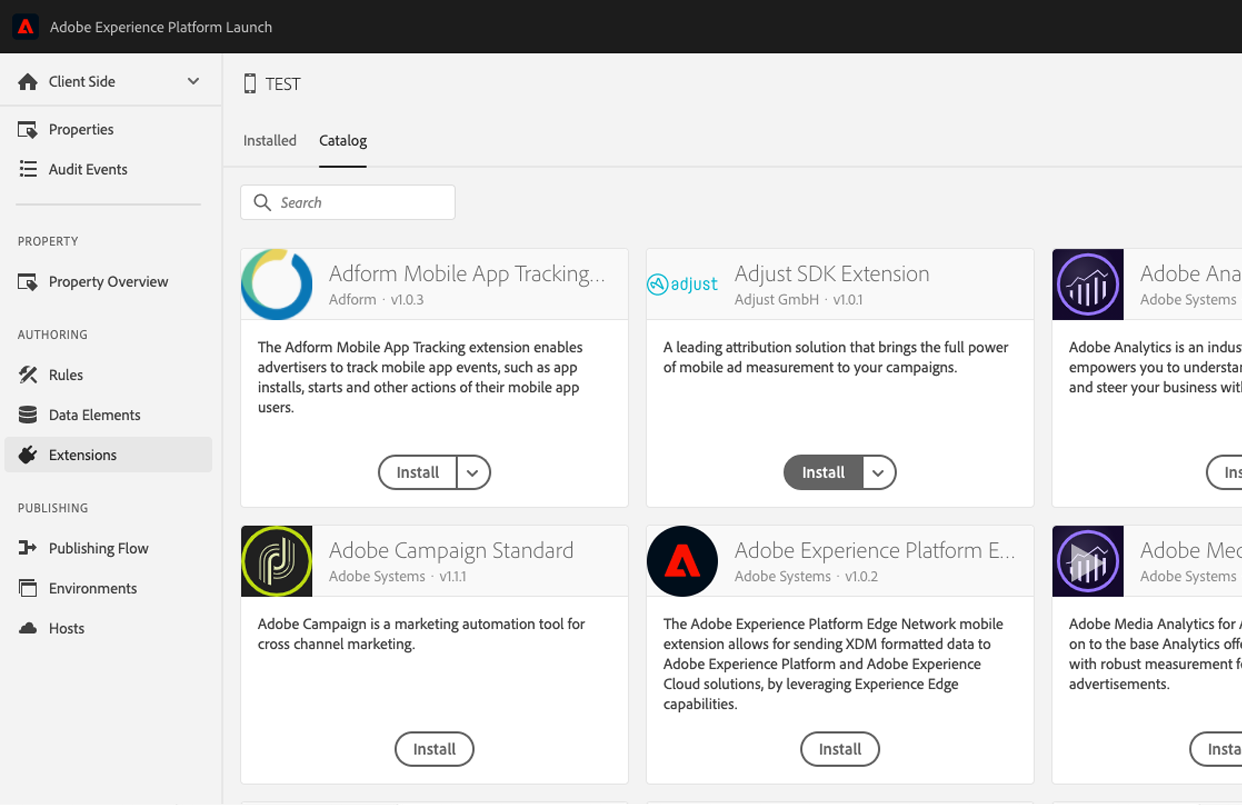
15. Adobe Experience Platform

Adobe Experience Platform Agent Orchestrator supports Adobe’s agentic AI tools, enabling autonomous, data-driven decision-making across marketing, content, and customer experience operations. These agents operate at scale to plan, support, and optimize customer journeys by reasoning over real-time enterprise data.
Key features include:
- Reasoning engine: Interprets user objectives, constraints, and context to determine the best course of action across marketing and CX workflows.
- Conversational interface: Enables interaction with agents through AI Assistants, supporting natural language commands and queries.
- Workflow optimization: Agents like the Workflow Optimization Agent help teams manage project momentum and mitigate risks in tools such as Adobe Workfront.
- Custom agent creation: The Agent Composer (coming soon) allows businesses to design and configure agents for specific workflows and outcomes.
- Enterprise data integration: Leverages real-time customer data and content from Adobe and third-party systems to enhance agent decision-making.
- Governed AI operations: Built with enterprise-grade security, privacy, and responsible AI practices, supported by an AI ethics review board.

Source: Adobe Experience Platform
16. Braze

BrazeAI™ Agents are agentic AI tools to automate, personalize, and optimize customer engagement across channels. Integrated within the Braze platform, these agents enhance marketing operations by executing tasks like journey orchestration, decisioning, and campaign management using first-party data and conversational interfaces.
Key features include:
- BrazeAI Operator™: A conversational tool that accelerates marketing workflows like content creation, insights discovery, and automation through simple prompts.
- Agent Console: Allows users to create, manage, and deploy agentic workflows for lead scoring, profile enrichment, localization, and more.
- Decisioning Studio: AI agents optimize customer messaging by autonomously selecting the best content, channels, timing, and frequency for each user.
- MCP Server integration: Enables agents to read Braze’s real-time data and interact with external models (e.g., OpenAI, Anthropic) for advanced personalization.
- Cross-channel execution: Agents operate across email, mobile, web, and messaging channels to ensure unified, data-driven engagement.
- Custom agent support: Build agents tailored to business use cases directly in Braze’s Canvas interface.
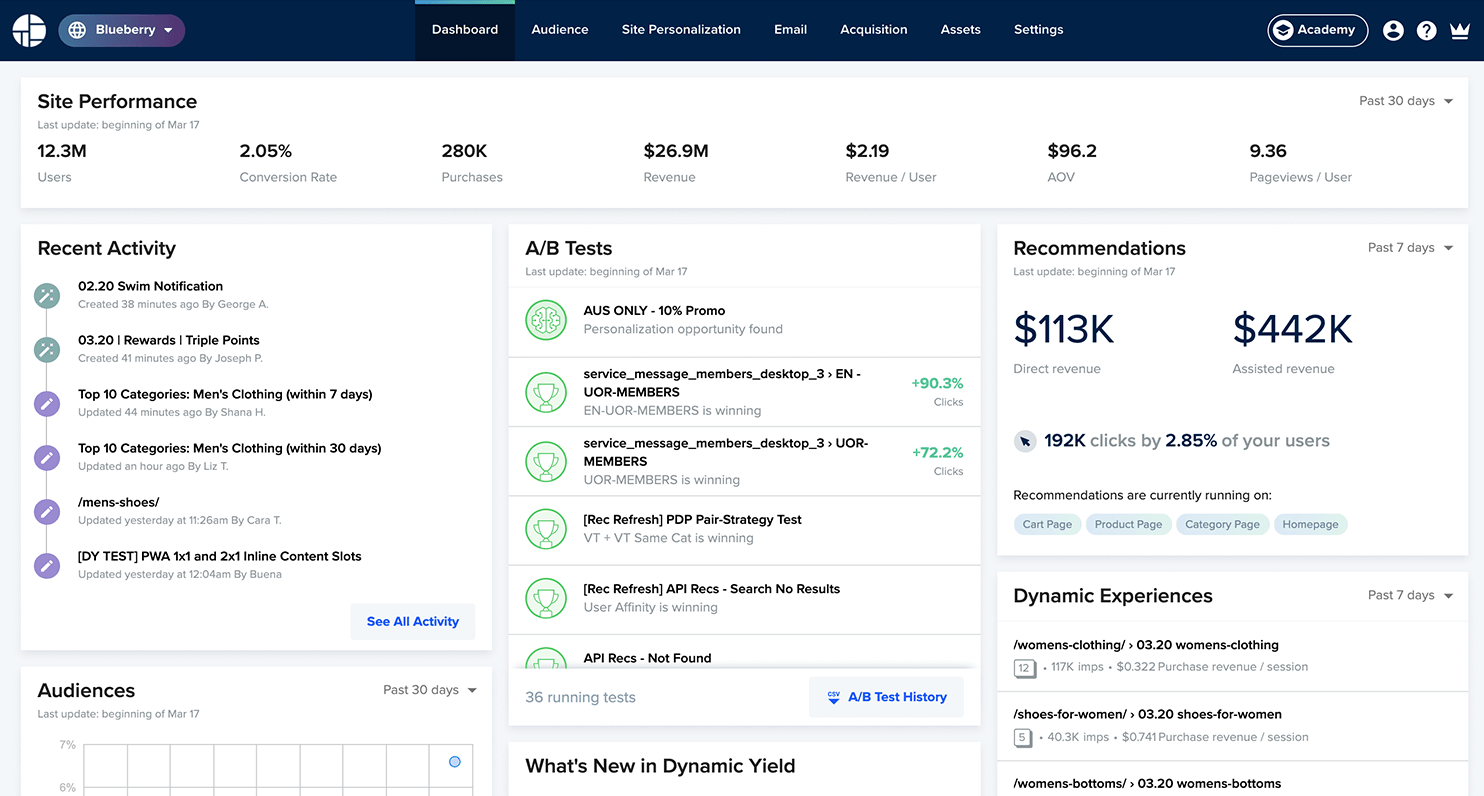
17. Dynamic Yield

Dynamic Yield offers an agentic AI-powered personalization platform to deliver one-to-one experiences across web, email, mobile apps, and other digital touchpoints. Its modular architecture, centralized AI engine, and deep learning capabilities enable organizations to automate decision-making, optimize creative content, and simulate human-like interactions.
Key features include:
- AdaptML™ decision engine: Uses predictive modeling, NLP, and deep learning to determine the best content, products, and offers for each user.
- Shopping Muse conversational agent: Simulates in-store assistance through natural dialogue, offering tailored product bundles and recommendations.
- AI-powered insights: Automatically uncovers personalization opportunities and generates executive-ready reports to guide strategic decisions.
- Creative automation: Personalizes visual and written content at scale using generative AI, reducing time spent on repetitive tasks.
- Experience OS architecture: Centralizes data, taxonomy, and personalization logic to ensure consistency across channels and systems.
- Modular integrations: Supports personalization across web, email, mobile, APIs, and notification channels, while enabling custom algorithm development via Algorithm Studio.

Source: Dynamic Yield
Software development
18. OpenAI Codex

OpenAI Codex is a cloud-based agentic AI tool for software engineering tasks. Powered by the codex-1 model, it operates autonomously in isolated environments where it can read, edit, and test code pulled directly from a user’s repository. Unlike basic code assistants, Codex handles tasks like writing new features, answering codebase-specific questions, fixing bugs, and submitting pull requests.
Key features include:
-
- Parallel task execution: Codex can manage many coding tasks simultaneously, each in its own cloud sandbox with access to the relevant repository files.
- Autonomous code operations: It performs end-to-end software engineering tasks (writing, testing, refactoring, and fixing bugs) without requiring detailed human input at each step.
- Environment configuration: Users can configure Codex’s containerized runtime to match their real development environment, ensuring compatibility and reducing integration issues.
- Integrated feedback loop: Codex iteratively runs tests, checks linting, and validates outputs, only concluding tasks when conditions pass, or escalating when failures occur.
- Verifiable output: Every action Codex takes is documented through terminal logs and test results, providing traceability for manual review or approval.
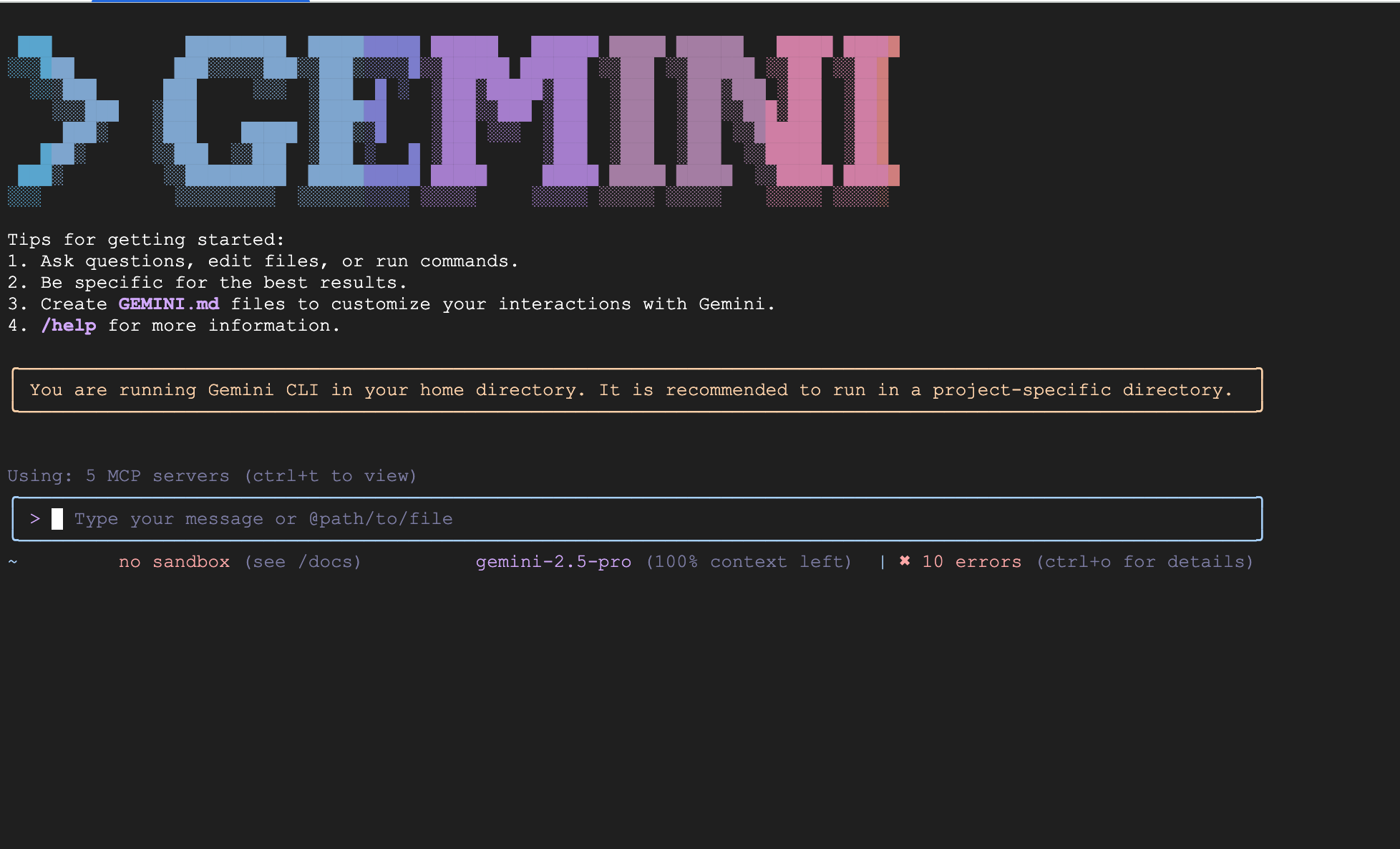
19. Gemini CLI

Gemini CLI is an open source command-line AI agent that runs Gemini models locally or via remote servers directly from your terminal. It uses a reason-and-act (ReAct) loop to solve complex problems by combining AI reasoning with actions through built-in tools and external systems. While optimized for software engineering tasks like debugging, feature development, and test improvement, Gemini CLI is also a general-purpose assistant.
Key features include:
- ReAct-based agent loop: Gemini CLI follows a reason-and-act cycle, combining step-by-step thought processes with direct execution through tools or shell commands.
- Code assistance and automation: It can fix bugs, write new code, improve test coverage, and automate repetitive developer tasks from the terminal.
- MCP server integration: Supports both local and remote Model Context Protocol (MCP) servers, enabling flexible access to model capabilities and persistent memory.
- Built-in developer tools: Ships with tools like grep, file read/write, and terminal access, allowing the agent to interact with the local file system and shell environment.
- Yolo mode: Enables faster task execution without extensive confirmation steps, useful for advanced users who want quicker iterations.

Source: GEMINI CLI
20. AutoGPT

The AutoGPT Platform is an end-to-end system for building and managing autonomous AI agents that operate continuously in the cloud. It allows individuals and businesses to automate complex workflows using low-code tools and intelligent agents that execute tasks without constant supervision. It is suitable for long-running, trigger-based automation.
Key features include:
- Low-code workflow builder: Design automation pipelines without needing deep programming expertise, using drag-and-drop tools and configurable logic blocks.
- Autonomous and continuous agents: Deploy agents that run indefinitely in the cloud, responding to events and triggers without manual intervention.
- Reliable long-running execution: Built for predictable performance, AutoGPT supports stable, ongoing operations with minimal downtime or failure.
- Workflow customization via blocks: Create workflows using modular “blocks” that represent actions like API calls, data transformations, conditionals, or AI model invocations.
- Integrated agent marketplace: Access a growing library of pre-built agents ready for deployment or customization, accelerating time to value.
Related content: Read our guide to AI avatar (coming soon)
Conclusion
Agentic AI tools represent a significant shift in how work gets done, moving from static automation toward systems that can reason, act, and adapt independently. These tools bring new levels of autonomy to software, handling complex tasks across multiple domains with minimal oversight. By intelligently managing workflows, adjusting to dynamic conditions, and collaborating with humans and systems alike, agentic AI tools offer a framework for scaling productivity, accelerating innovation, and rethinking how organizations operate.
Was this post useful?
Thank you for your feedback!