



What Is Innovation in Education and Why It’s Important?
Let’s talk about innovation in education, discuss a few examples, and find out why this focus on innovation education is important.
In a recent post, we explored innovative teaching strategies and how educators can deploy these strategies in the classroom. Let’s talk a bit more about innovation, such as what it is and, more specifically, innovation in education. Why this focus on innovative education? Skill gaps.
As teachers, our goal is to educate students. Educated students are then able to advance their education further – to get whatever degree or certification they need – to eventually succeed in a career that they find rewarding and give back to their community.
One of the key challenges employers face today is that their employees are struggling to meet the challenges of ever-changing skills requirements. In fact, recent industry research now identifies skills gaps as the single biggest barrier to business transformation, with roughly two-thirds of employers naming them a major obstacle, and nearly 40% of workers’ core skills expected to change in the years ahead.
The drive to innovate is increasingly shaped by new technology. Generative AI in particular has moved from novelty to everyday classroom tool, changing how educators plan lessons, personalize learning, and create materials. Knowing how to harness these capabilities (and teaching students to use them wisely) has quickly become part of what it means to teach innovatively.
What does the skills gap have to do with innovation in education? Well, let’s first unpack what innovation in education even means.
Editor’s note: Updated the article to refresh skills gap statistics, add new research on generative AI in the classroom, and reflect current education innovation trends as of 2026.
What is innovation in education?
Innovation is one of those words we like to throw around whenever possible. To innovate means to make changes or do something in a new way. To innovate does not require you to invent. Baked into innovation are creativity and adaptability.
Innovation in education isn’t a specific term with fixed definitions. The spirit of innovative education is an openness to looking with fresh eyes at problems and to address them in different, new ways. It is a recognition that we don’t have all the answers and are open to new approaches to improve, such as methods of knowledge transfer with innovative teaching strategies.
Innovation in education can be:
- Recognizing that students are better served by a flipped classroom where they watch lectures at home and complete assignments in the classroom.
- Introducing more technology in the classroom to create a blended classroom where students experience technology as they would in the real world.
- Providing greater ways to facilitate clearer and better communication between school districts’ parents with powerful video tools.
Innovation in education comes from identifying problems, watching and learning from others, developing new methods to address these problems, and iterating on them when these experiments don’t necessarily give the results you need.
Why is innovation important in education?
Charles Darwin never said, “It is not the strongest of the species that survives, nor the most intelligent that survives. It is the one that is most adaptable to change.” Regardless, let’s consider that a moment.
It is nearly impossible to predict or keep pace with the rate of change in today’s workplace. Accepting that, we can then agree that perhaps more important than the knowledge we have is the ability to adapt and evolve.
How can we teach a student to adapt? Well, in most industries, the catalyst of change is innovation. There are always improvements to be made. Innovation education helps prepare students for a dynamic workplace by providing them opportunities to develop skills such as creativity, adaptability, and resilience. As AI reshapes nearly every field, the ability to keep learning and to work effectively alongside intelligent tools is fast becoming one of the most valuable skills of all.
As educators, we can leverage innovation in education to improve student outcomes from a purely academic standpoint as well as to develop those soft skills that students need to succeed in life. We can also introduce more and more technology that students will need to be comfortable with overtime.
What are examples of innovation in education?
As we’ve already started to see, innovation in education can come in many forms. Remember, it is not just about introducing new technology into the classroom. It can be a new method of teaching for a specific project or topic.
- Project-Based Learning (PBL) – Help students identify a real-world problem and develop a solution for it. Introduce a PBL-unit as part of a larger lesson where students can exercise their creative thinking, problem-solving, and collaboration with other students.
- Blended Learning – Blending learning combines online learning with traditional classroom learning. Students must become comfortable with online tools and using the internet to contribute to their learning. A blended learning approach gives students the ability to discover how best to use tools that they will rely heavily on in their professional lives.
- EdTech – Educational technology (edtech) typically refers to any software, application or service developed to enhance education. We must be careful not to go too far into the deep-end but introducing technology in the classroom is important. Innovative classroom technologies often mirror the innovations outside of education. So, the more students engage with technologies in the classroom, the better prepared they will be to engage with and through technology in the workplace.
- AI-Assisted Learning – AI tools such as AI assistants and agentic avatars can act as on-demand tutors, generate practice questions, and adapt explanations to each student’s level. Used thoughtfully, they let teachers offer more personalized support and give students a safe space to explore ideas and receive instant feedback.
How to adopt innovation with EdTech platforms?
As we mentioned above, innovative education does not have to mean introducing technology into the classroom. However, educational technology certainly has its role in innovation in education. Sometimes edtech facilitates innovation in education by making possible what wasn’t possible before. Think about how edtech has helped schools keep teaching even when in-person classes weren’t possible. Schools and teachers innovated by offering new methods of knowledge transfer. Increasingly, that edtech comes with AI built in; tools that draft lesson plans, generate quizzes, and tailor content to different learners in seconds.
Most of us will first mention learning management systems (LMS’s) when we think of educational technology. Learning management systems are often the centerpiece of a school’s educational technology. But let’s face it, unless you are an IT Administrator or tasked specifically with onboarding a new LMS, you’re not going to be introducing a learning management system into your classroom (TBH, you wouldn’t need to).
So, let’s consider some innovative educational technology that you could introduce into the classroom:
- Feedback assessment tools – Feedback is critical both for students to receive and to give. It can help teachers gauge understanding in real time and get a pulse check of the class. Feedback assessment tools (polling, surveys, forms, and knowledge checks) are also incredibly easy to bring into the class. We even use them today by having students raise their hands and count their responses. Feedback assessment tools provide a fun way for students to leverage technology in the class. Additionally, it can save teachers time by aggregating the data and saving responses to review later.
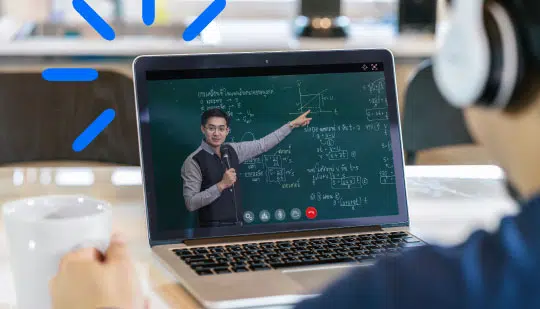
- Video conferencing and virtual classrooms – Though millions of teachers and students have become comfortable virtual classroom professionals, virtual schools and virtual academies have utilized powerful virtual classroom platforms as their primary point of face-to-face instruction for years. Virtual classrooms are video conferencing platforms built with specific tools for learning. Conduct virtual classes or provide options for students to collaborate virtually. Students and teachers alike need to become more comfortable with video.
- Video projects – Our students are digital natives. They are also video creators. Whether they are on TikTok, YouTube, Instagram, or Snap, you can be sure that students know their way around video. Leverage their passion by bringing video into their projects. Assign projects for student collaborators to create a video around specific topics. Not only will they exercise their creativity, but they’ll also sharpen their communication skills as they work together.
There are many angles to look at so don’t limit yourself. Search online or just ask what your fellow teachers are doing.
Kaltura Virtual Classroom as an example of education innovation
Kaltura virtual classroom has been designed and built for education and training. Teachers can conduct interactive, face-to-face classes that actively engage remote students. Teachers are not simply connecting face-to-face to lecture passive students. The platform provides tools that allow teachers to introduce innovation in education.
- Real-time polling – Teachers can use a live polling tool to pulse check students. Of course, they can ask students on video to raise their hands or click a hand raise button, but even better is a polling tool to gauge measurable feedback. With preset polling options, teachers can launch a poll with a click. Students then select their reply, and teachers see real time aggregate results as well as what each student replied.
- Quizzing – Sometimes polling isn’t enough. We need to gauge a deeper understanding in real time and use that information to inform the rest of the lesson. Create quizzes with different question types for students to complete in the class. Teachers can give the quiz and see real-time results. The results are also available to review after class. With this information, teachers can be more confident that students are understanding the material presented or move to reinforce items now, in class, rather than finding out later.
- Interactive whiteboards and file annotations – We want students actively participating in their learning. What better way to encourage that than with an interactive whiteboard? A whiteboard is a great space for students to share their ideas, collaborate, and brainstorm.
- Video in the classroom – Video is incredibly powerful at explaining complex topics in digestible ways. Kaltura virtual classroom provides opportunities for teachers to leverage their own video library as well as video sources like YouTube in the class to drive home their lesson plan. When teaching, we have to make things dynamic and interesting. We cannot shy away from producing multimedia experiences such as utilizing presentations, images, whiteboards, and, of course, video.
- Breakout rooms – Remote and distance education typically ignored peer engagement, but as educators, we know that peer engagement is critical to any student’s success in the classroom. Kaltura virtual classroom breakout rooms provide awesome ways for teachers to host directed breakout room experiences. Students can engage one another safely around content provided directly by the teacher with a single click of a button. Encourage branching scenarios, role play, and group projects in breakout rooms.
How AI is reshaping innovation in education
Few forces have changed the conversation around innovation in education as quickly as generative AI. In just a few years, it has moved from an experiment to a daily companion for many educators, helping them plan lessons, build assessments, and differentiate materials for students with very different needs.
The time savings are real. Recent national research found that a majority of K-12 teachers used AI tools over the past school year, and those who use them weekly reclaim close to six weeks across the year by automating tasks like lesson planning, generating classroom materials, and drafting communications to parents.
That reclaimed time can be reinvested directly in students. The same research found that close to six in ten teachers believe AI improves the accessibility of learning materials for students with disabilities, through tools like text-to-speech, translation, and instant reading-level adjustments.
Of course, innovation here isn’t about handing the classroom over to a machine. The opportunity is to use AI to personalize learning, free educators from busywork, and build the AI literacy students will need in their careers, while teaching them to question, verify, and think critically about what these tools produce.
The future of education innovation
Very often, we find ourselves in a time and place where the status quo is the goal. We may be coasting with enough success in the classroom that there isn’t much appetite to shake things up. For better or worse, that isn’t the current landscape and not one we can expect to return to anytime soon.
Innovation in the classroom has been unleashed. School districts have quickly realized that they’re behind and will look to not only catch up but also surpass their innovation deficits. These innovation trends are only going to continue and accelerate what we’ve seen built over recent years.
We can expect to see many more investments in personalized learning, greater acceptance of blended and hybrid learning, a build-up of asynchronous learning modules to promote independent study, and more brave innovators embracing artificial intelligence, augmented, and virtual reality in the classroom.
Embracing innovation in education promotes critical thinking, a sense of adventure, and an openness to adapt that will serve our students in the classroom. It will provide them with the necessary tools to tackle the challenges of their future workplace and give them the confidence and skills to continue to adapt.
Was this post useful?
Thank you for your feedback!
